Xah Lee, 2007-01-09
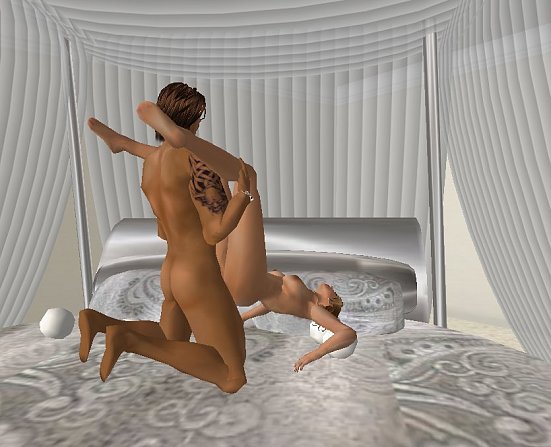
above: A screenshot of a location in Second Life.
This place is part of a land called “The Future”. This dome and most things in it are built by Henry Segerman↗.
Second Life is a online virtual world with 2 million accounts as of 2006-12, and reportedly 10 thousand users logged in at any moment. Basically, you operate a software that shows a interactive computer-generated 3D world much like video games, but everything in the “game” is constructed by the users themselves, and you can interact with other users, including buying and selling virtual land with real money. What people do inside Second Life is entirely up to them (as in real life). And, as it happens, what people do mostly in Second Life are pretty much what people do in real life. The major activities are: sex, shopping, socializing, dancing.
(notable differences is that in Second Life, there's no famine, misery, war. (There are some politics (pertaining to Real Life politics, but also spontaneous in-world power struggle) and religion.) Since, after all, Second Life is a game and people don't die in it. There're no survival pressures.).
My mathematician friend Henry Segerman introduced me to 2nd life. (also because it appeared in Time Mag in 2006-12.)
Part of my interest in Second Life is to build geometric models. (See Introduction to 3D Graphics Programing) I have for the past couple years sought for a software platform/system where i can build 3D objects, with abilities to do interactive manipulation (such as moving a slider to change a parametric surface's parameter), dynamic rotation (viewing from different angles instantaneously), animations (such as morphing that shows geometric processes), and most of all, walk-thru in it as if it is a building (e.g. the perception of actually walking on a moebius strip↗ or Klein bottle↗ is vastly different than just viewing it.).
As far as my experiences goes, no software platform for 3D graphics are close to the ideal of what i need to do. They lack one feature or the other, or otherwise requires the programer to be a specialist with years of dedication in learning the tool. For example, Mathematica↗ has great collection of math functions but no interactive graphics features. POV-RAY↗ and 3D-modelers like AutoCAD↗ can do great in building 3D objects but they are not designed for interactivity, animations, or walk-thru. Java the programming language↗ allows one to write applets that does rotation and interactive manipulation but programing in Java is extremely unnecessarily complex and yet it is still not possible to do walk-thrus. The one class of platform that does all these, is 3D Game Engines↗. But alas, they take a dedicated game programing specialist to be able to use it. Second Life changed all this. (see Requirements For A Visualization Software System For 2010.)
Second Life is not just the answer to my mathematical fantasies, but because of its Real-World nature, being run and build by real people, and with scarily (and questionable) real money market of the virtual dollars it uses, is nothing but a technological revolution with great social impact. It is essentially the virtual-3D-world-wide-web dream of VRML↗ envisioned around 1995.
above: Anshe Chung on the cover of Business Week 20060501.
Anshe Chung↗ is famouly known for being the first to become a (real world) millionaire by selling entirely virtual items and virtual services inside Second Life.
For a wikipedia introduction, see: Second Life↗
Addendum, 2007-01-21, 2007-03-20.
Note that Second Life is not the first “virtual world” (however that is defined), and, it has many competitors, including: Entropia Universe↗, There (Internet service)↗, IMVU↗, Dotsoul↗, Active Worlds↗.
When virtual world like Second Life becomes household activity as the internet is today, it will probably not be known as Second Life or run by one single company, but diverse companies with servers all over the world, where there is a unified virtual world all the world's people can be in. (This situation may be likened to The Internet in its early history (1980s-1995). Or, perhaps also similar when telephone network was in its pioneering days, or the Instant Messaging networks that is coverging today.)
Here's a interesting article that describes how Second Life is really a Pyramid scheme↗ , and all the economy news are delusional in nature: SecondLife: Revolutionary Virtual Market or Ponzi Scheme?↗ by Randolph Harrison, 2007-01-23. I believe what the article said is largely true. Here's a follow up article: The Linden dollar Game↗, 2007-02-20.
Youtube's anshe chungs cnet interview debacle video↗. 2007-01-24.
Page created: 2007-01. © 2007 by Xah Lee.