Milk, Tits, Caryatids (2003)
Quadruple Udders

Personally, i find this ad and the prospect engaging. One day i might suckle on wenches with a quadruple of udders. And, for the ladies, there might be double dicked men.
Romulus and Remus
Am reminded of this sculpture.
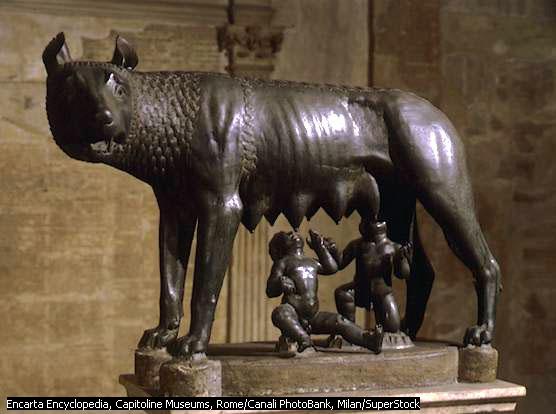
Here's a quote from Encarta:
Left to drown at the edge of the flooding Tiber River, the legendary twins Romulus and Remus were found and raised by a she-wolf. As men, the brothers returned to the spot where they had been abandoned and founded the city of Rome. The Romans celebrated the festival of Parilia, today called the Natalis Romae, or the birth of Rome, on April 21 to commemorate the day the brothers founded the city.
A enticing sculpture. As far as i know, rearing alien species happen in nature. As some village farmers or pet raisers might attest, bitch or doe suckle kittens or puppies or kids or otherwise cubs are sometimes reported with love. A world as one.
But also note the prologue in the story: “Left to drown”. The general term for such act is called murder, which is a recurring theme in animal behavior among carnivores. The motive is often subsistence or power. Fighting for a mating partner comes immediately behind.
Among human animals, a recurring intrigue is the “left to drown” instead of “outright kill”, as we can see in this Remus n Romulus legend. This intriguing behavior is not just legendary but i suppose also reflect some reality. From evolutionary psychology point of view, perhaps not wiping out foe in toto is beneficial to the specie as a whole, because it preserves varieties in seeding. On the other note, such behavior in legends always come back against all odds and bring death to the doer. (In Remus'n'Romulus, their uncle killed their dad to gain power and left the twin to drown. The outcome of not killing outright is the twin not dead; who came back and killed the uncle, built Rome.) This recurring element in human legends perhaps reflect the fact, that the human animals like to think of themselves as different, by hinting a possession of a sophisticated emotion “mercy” not perceived in other brutes. And this is emphasized by the story's ending where mercy is incompatible with the merciless nature, where the survivor always win against odds and come back to mete out vengeance.
In Chinese, a idiom of this theme says: 暫草要除根。暫草不除根,春風吹又生。 (“Weeding must uproot; otherwise, spring brings it on”). A similar saying in English goes like this: “If you strike the king, you had better kill him”.
Stanford University Gate Stature
I'm reminded of this stature:
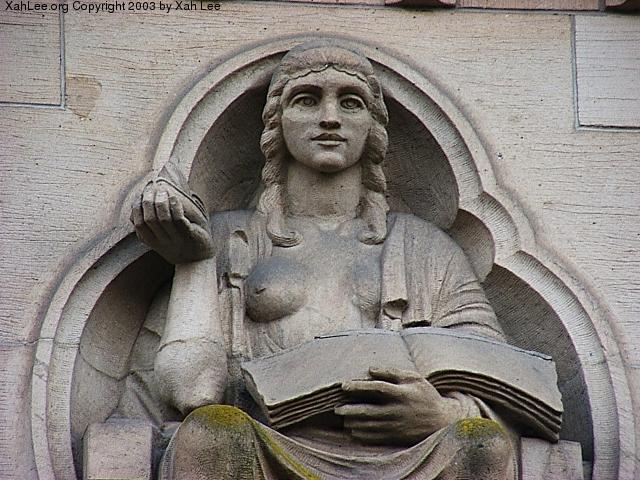
Stanford University , the name of my pain.
In the early 1990s i applied twice but failed twice. (Stanford U is one of the Ivy League universities, located at Palo Alto, California, which is about 60 kilometers south of San Francisco. Ivy League refers to the following colleges: Brown, Columbia, Cornell, Dartmouth, Harvard, Princeton, U of Pennsylvania, Yale.) Those well-to-do schoolers, such as those PhD tag wearers churned out yearly by Ivy League schooling institutions, are the names of my pain. I want to ram my head with their heads, and see their heads crushed bloody.
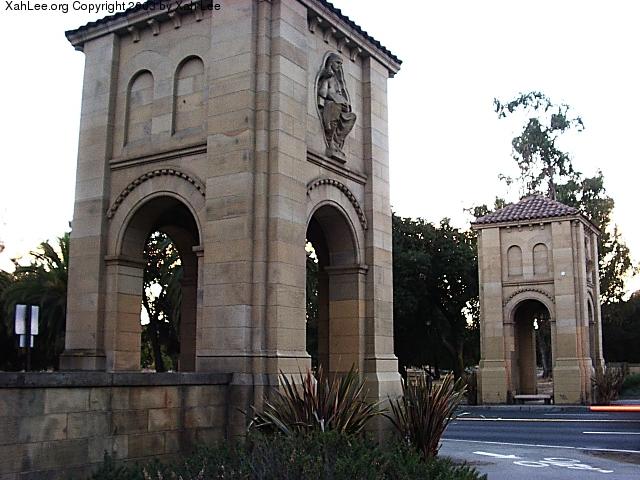
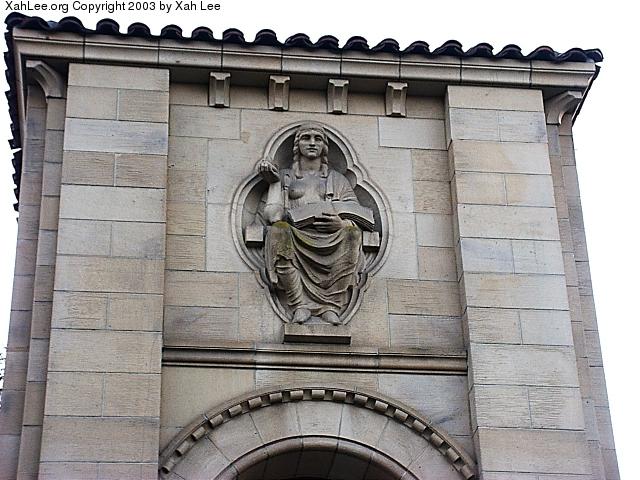
I wonder who or what these two lasses are or represent. There's no caption or inscription around the two rises, nor a name for this main gate as far as i know.
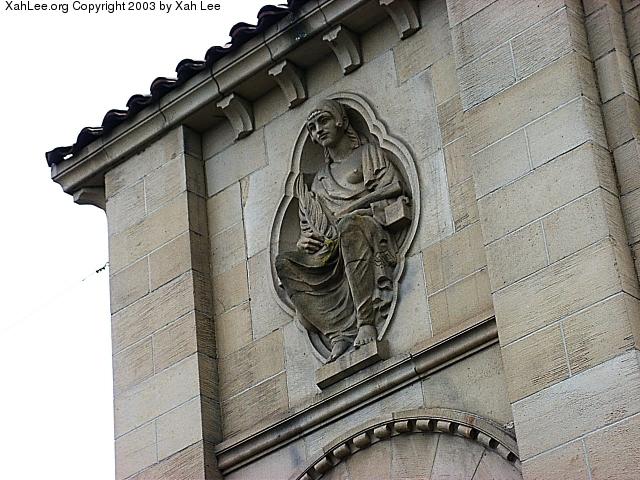
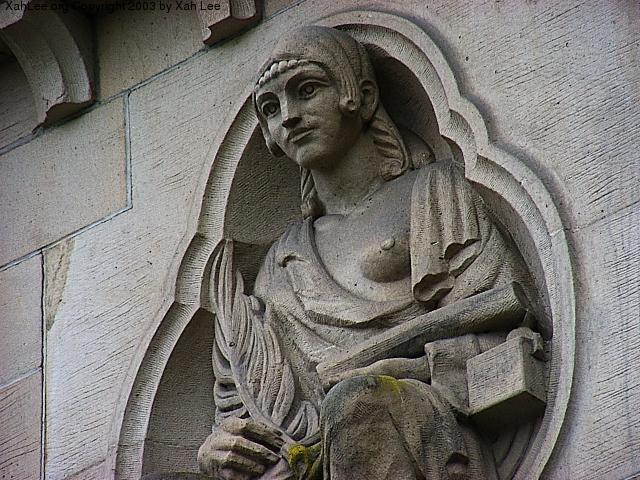
Caryatid
Recently i also learned that a sculptured pillar in a figure of a female is called caryatid. The male counterpart is called Atlas. The sculpture at the prow of ships, often female or bestiary, is called Figurehead.
The etymology of Caryatid is from Latin caryatides and Greek karutides, literally “maidens of Karuai”, referring to the priestesses of Artemis, a village of Laconia in southern Greece with a famous temple to Artemis. (Artemis is a Greek goddess of hunting and wild-animals and fertility. She is the twin sister of Apollo, and is daughter of Zeus and Leto.) [see A Love of Mythology of the Greeks]
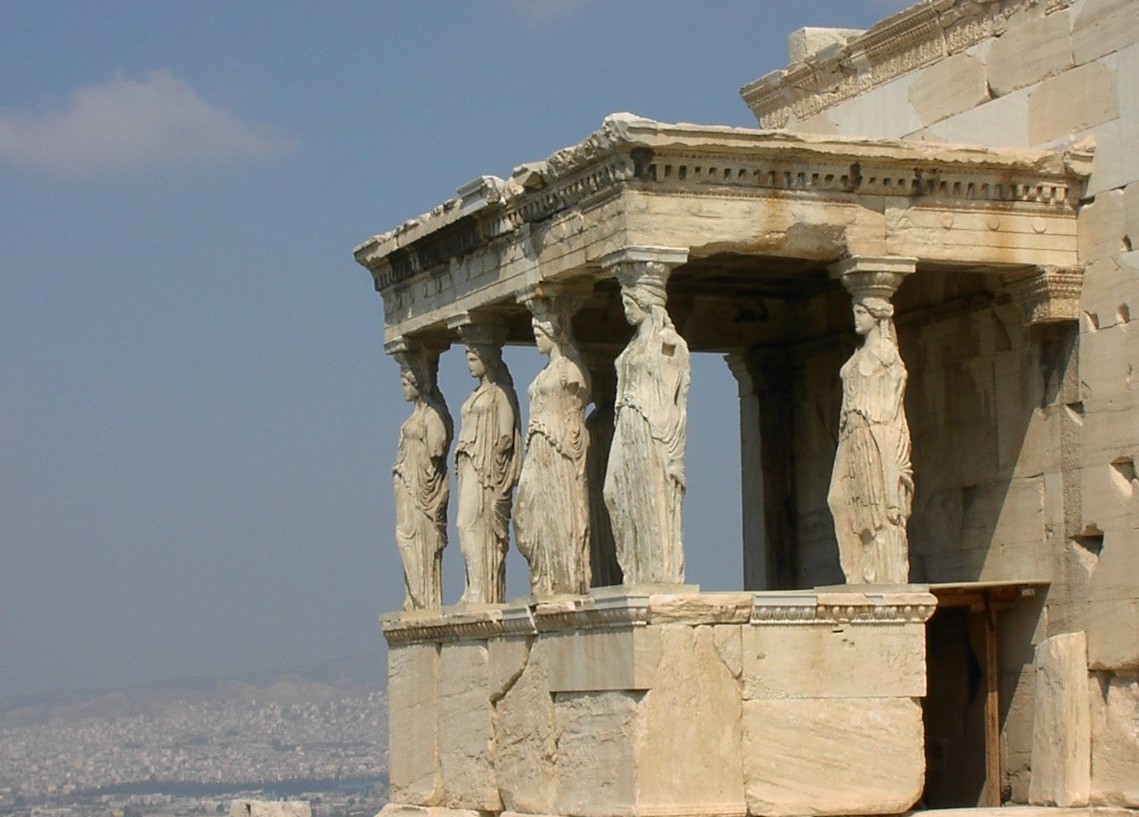
Porch of Maidens, Erechtheum
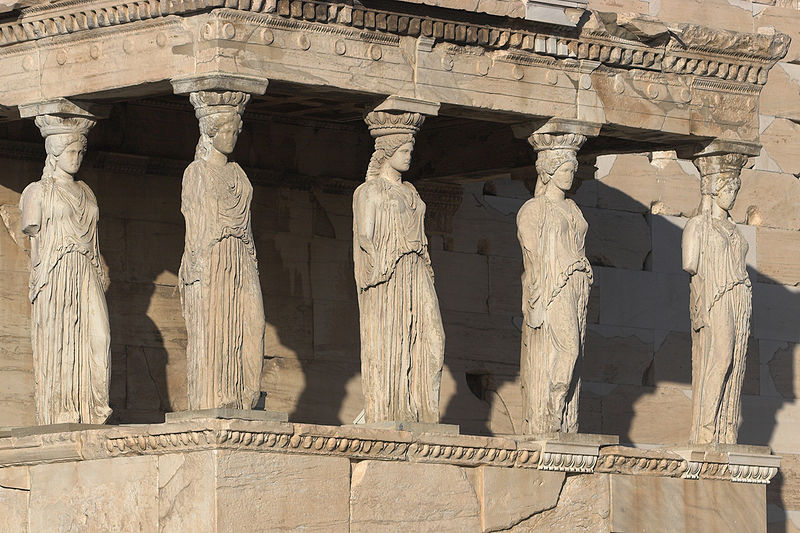
Quote from Wikipedia Caryatid:
A caryatid (Greek: Καρυάτις, plural: Καρυάτιδες) is a sculpted female figure serving as an architectural support taking the place of a column or a pillar supporting an entablature on her head. The Greek term karyatides literally means “maidens of Karyai”, an ancient town of Peloponnese. Karyai had a famous temple dedicated to the goddess Artemis in her aspect of Artemis Karyatis: “As Karyatis she rejoiced in the dances of the nut-tree village of Karyai, those Karyatides, who in their ecstatic round-dance carried on their heads baskets of live reeds, as if they were dancing plants” (Kerenyi 1980 p 149).
Some of the earliest known examples were found in the treasuries of Delphi, dating to about the 6th century BC, but their use as supports in the form of women can be traced back even earlier, to ritual basins, ivory mirror handles from Phoenicia, and draped figures from archaic Greece. The best-known and most-copied examples are those of the six figures of the Caryatid Porch of the Erechtheion on the Acropolis at Athens.
Although of the same height and build, and similarly attired and coiffed, the six Caryatids are not the same: their faces, stance, draping, and hair are carved separately; the three on the left stand on their right knee, while the three on the right stand on their left knee. Their bulky, intricately arranged hairstyles serve the crucial purpose of providing static support to their necks, which would otherwise be the thinnest and structurally weakest part.
And here comes the WASP:
One of the caryatids was removed by Lord Elgin in order to decorate his Scottish mansion, and was later sold to the British Museum (along with the pedimental and frieze sculpture taken from the Parthenon). Athenian legend had it that at night the remaining five Caryatids could be heard wailing for their lost sister. Elgin attempted to remove a second Caryatid; when technical difficulties arose, he tried to have it sawn to pieces. The statue was smashed, and its fragments were left behind. It was later reconstructed haphazardly with cement and iron rods.
Full article here: Elgin Marbles.
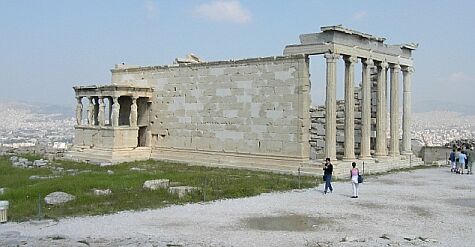
The Erechtheum (Greek: Ἐρέχθειον Erechtheion) is an ancient Greek temple on the north side of the Acropolis of Athens in Greece.
Harisu
All the tits and marble reminds me of this porn pic i gathered in late 1990s.

This semi-nude demi-goddess in the photo above is a Korean transgender actress Harisu (河莉秀).
Not until many years later, i learned, this goddess i masturbated to wasn't a she!!